Around the time I started birding (listing), I did a trip to Mt Lewis as a volunteer on a large-scale insect biodiversity survey. I had no idea back then that I was staying in one of the most famous birdwatching locations in Australia. I had a goal of seeing one new species (LIFER) a day, which I fairly easily managed to achieve given that I was immersed in one of the hotspots for vertebrate endemism in the country… the great Chris Burwell provided a lot of advice and help with my identifications, and I gradually got my eye in. However, it was the wet season, and we were experiencing torrential rain most days. This put a bit of a dampener on our insect collection, and sometimes meant that we couldn’t go up the mountain. I prowled the grounds of Kingfisher Lodge restlessly – until I found the library. Inside, I found a recently published account of an Australian ‘Big Year’ (Sean Dooley’s ‘The Big Twitch’) and consumed it with great glee. Until then, I had no idea that there was a semi-secret network of birders all throughout the country. People who were obsessive listers and compulsive twitchers – people who could barely function in human society but could tell you the age and sex of a dull brown shorebird slurping mud 1 km away. In time, I would come to join this elite and secretive inner circle of birders… but that time was many years away.
The inner circle
One of the lines from the book that jumped out at me was that ‘seabirders are real birders’ and that ‘seabirding is hard’. What in the helly was seabirding? I went to talk to Chris about it, and he described the concept of a pelagic to me. Immediately, I was fascinated – although I knew nothing really about seabirds or what it would be like to try and identify them. I remembered a family trip to some barrier reef island where everyone on the boat was seasick except for me, and thought that was an encouraging sign. In the evenings, I started patrolling my copy of Slater, examining the tubey’s. I was boggled at first by the diversity and the endless variations on the theme of white, black and grey. I started thinking about how I could head out to sea to have a look at some of these beasts and when I got home I found the (now stygian) SOSSA forum. In Queensland there was basically one way to see these birds, and it was to get on Paul Walbridge’s trips that ran on the Grinner. I did not understand the need to book in advance – had no concept that there could be people who would be targeting a specific time of year, or species (or just doing every single trip in case they missed something) – and so I tried to get on the next trip I could. I ended up getting on the September trip later in the year. It was good, and I had fun, but it didn’t give me the seabirding bug.
It wasn’t until that Christmas later that year that I would acquire a seabirding obsession. Strangely enough, it was through omission; I had asked Santa for a pelagic spot for Xmas, but in one of the great tragedies of our time, I couldn’t get on the boat (it had been fully booked for months!). Oh, how this haunts me even today. On the birdline the afternoon of the January trip appeared those fateful words: POLYNESIAN STORM-PETREL.
The halcyon days of yore
Thus started my seabirding career, such as it was – the desire to see Poly got me on basically every boat that I could manage to find over the next decade. Like many others, I’ve now been to sea to look at birds more than a hundred times, racking up the LIFERS and the state ticks all the while. During my PhD in particular seabirding was a welcome escape and I went on as many trips as I could afford. But somewhere around 2021 I started to lose some of the joy of seabirding… the risk (time, money) to reward (new birds) ratio had skewed massively in an unfavourable direction, especially since I had started working full time (poor me). I’d also been lucky enough to have seen a hell of a lot of tubey’s, and went through a full year of trips with no new birds (pretty common really, but never easy to stomach). As such, the Christmas double header in 2021 was my last pelagic in Queensland… UNTIL NOW.
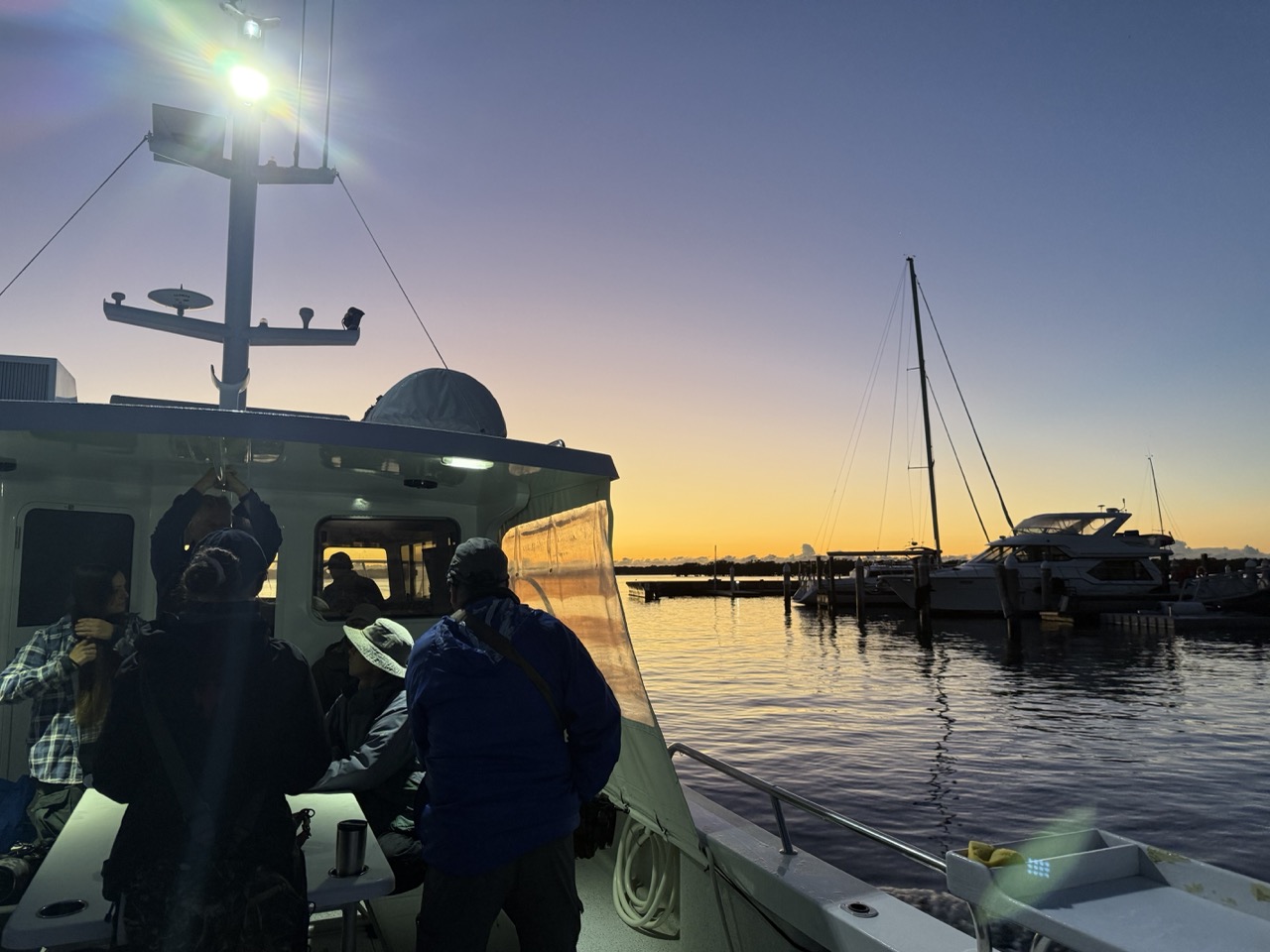
Conditions had been pumping, and there had been some crazy birds all up and down the east coast. I had seen an absolute MEGA seabird earlier in the week and so expectations were high. Rocking up under the cover of darkness it was comforting to see so many familiar faces… Paul and Craig (of course), but also Brian and Nikolas, as well as my fellow sea wulfs Andy, Gus and Stu. Stu and Andy had astonished me on my first few pelagics with their ability to identify tubey’s instantly, and Gus was the first other ‘young’ birder I’d met on the boat. Now younglings swarmed about everywhere yapping constantly – I suppose they were excited.
Astronomical, nautical or civil dawn? Bloody early regardless
The light was fairly ghastly as we arrived at the shelf, the three hour transit passing surprisingly quickly after my ~4-year ‘holiday’. Providence petrels began gathering at the back of the boat once we had some burley in and it wasn’t too long before they were joined by a cape petrel, one of the cutest seabirds. I had my ‘new’ camera with me for the first time on a pelagic and it got a good workout! Click the pictures for bigger versions (I’ve been retro-fitting this to my old posts too).
Cape Petrel (Daption capense)
A northern giant petrel showed up soon after that, which was a little grim – most of the other birds immediately became flighty after xe was sitting on the water. I fed the GP vast amounts of shark liver, until xe floated off down the slick replete. And then a 12-year vigil ended… a BULLER’S ALBATROSS was wheeling about and came straight in for a chew. Wow!!! A blocker no more. An hour or so later, three of these magnificent beasts would be around the boat. Unbelievable. But there was even more excitement to come.
Buller's Albatross (Thalassarche bulleri)
Kissing :3
A few Wilson’s started to gather in the slick, and a kermadec petrel was the next new bird in, but it didn’t hang around long. A couple of black-browed albies showed up and got some ooh’s and aah’s from the youngsters. It was a good day so far, with heaps of birds around the boat. There hadn’t been any changeover for a while but the albies were still putting on a great show (we ended up with 3 Buller’s and 3 black-browed). I was burleying hard when Gus hollered “WHAT’S THIS?!” – the words every seabirder dreams of – immediately followed by “it’s a Procellaria – IT’S A WESTLAND!!!” The bird had appeared from the north, coming in out of the glare of the sun, but was immediately apparent and loomed over the burley station as I picked my jaw up off the floor. There hadn’t been a westland petrel in Queensland for 20 years! Andy and I embraced, tears streaming down our faces. Things would never be the same.
The big one - Westland Petrel (Procellaria westlandica)
Sadly, the westland appeared a little indisposed, and was (at first) fairly listless on the water. Xe was probably just tired – later in the day, when I’d fed xir an absolute bucketful of shark liver, xe appeared to pick back up a bit. A black-bellied stormy showed up a little while later, along with a common noddy or two, but the last excitement of the drift arrived in the form of a beautiful young Gibson’s albatross. All too soon it was time to head back towards land… but the fun wasn’t finished yet.
On the way back in the wind steadily died off until the sea approached a glassy state, with only some light scale ripples. Sea monsters streamed past the boat, and we eventually flushed a pleustonic brown skua from the air-sea interface, which immediately took advantage of the situation and pounced on a hapless providence petrel. Happily (for the petrel), the Gibson’s barged in to take a look and ‘rescued’ the little hound before the skua could snuff its lights out. A young Indian yellow-nosed alby was the last new bird for the day. Craig saw it sitting on the water ahead of the boat, munching on a fish head.
Indo-Pacific Man-O-War (Physalia utricalis)
And thus concluded one of the best Southport pelagics of the past decade. It was a true privilege to share some time with the sea-dwellers (avian, invertebrate and human) again… I will return to the sea more frequently from now on… it is calling.